When Doing Nothing Becomes the Most Expensive Decision: The Compounding Consequences of Infrastructure Inertia
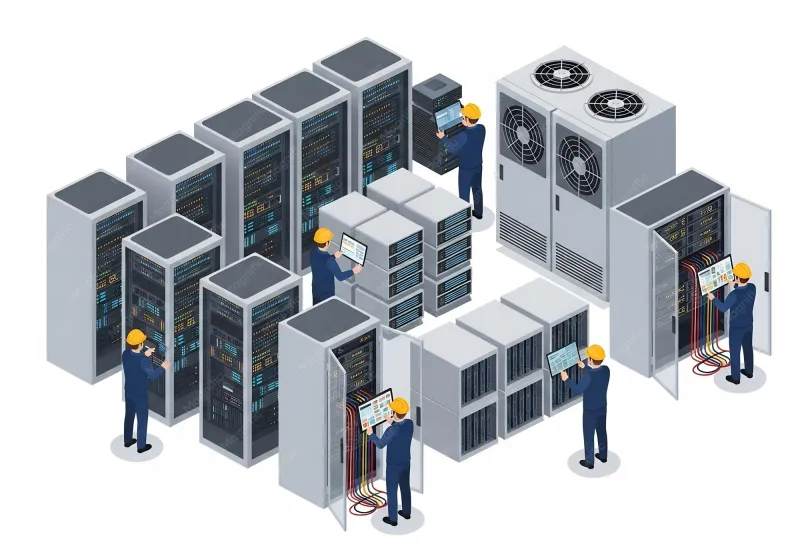
Photo: server room aging infrastructure data center technical maintenance, via img.freepik.com
The Illusion of Stability
There is a particular kind of false confidence that comes with a hosting environment that mostly works. Servers stay online, applications load within acceptable timeframes, and the support tickets remain manageable. For many IT teams and business owners, this quiet functionality is interpreted as a signal that everything is fine — that the infrastructure does not need attention.
But infrastructure does not age gracefully on its own. What appears stable on the surface is often a system gradually accumulating stress: outdated operating systems no longer receiving security patches, deprecated software dependencies held together by workarounds, and hardware approaching end-of-life thresholds. Each month that passes without modernization adds another layer to what engineers call technical debt — a term that describes the future cost of choosing a convenient short-term solution over a more sustainable one.
For businesses operating in the United States, where customer expectations around uptime and data security are increasingly shaped by regulation and competitive pressure, this debt does not stay quiet forever.
How Technical Debt Compounds in Hosting Environments
Unlike financial debt, which accrues at a predictable rate, infrastructure technical debt tends to compound in non-linear ways. A single unpatched vulnerability might sit dormant for months before becoming the entry point for a breach. A server running on an unsupported operating system may function without incident until a critical dependency update forces an incompatibility that takes the application offline for days.
Consider a mid-sized e-commerce company that has been running on a shared hosting environment configured three years ago. At the time, the setup was appropriate for their traffic volume and budget. Since then, the business has grown, their customer database has expanded, and their application has added several third-party integrations. The hosting environment, however, has not changed.
The compounding begins subtly. Response times creep upward. The database query cache, never optimized for the current data volume, begins to strain under peak loads. The SSL certificate management is manual, creating periodic lapses that browsers flag as security warnings. Each of these issues is individually survivable — but collectively, they represent a system operating near its breaking point.
When a promotional campaign drives a traffic spike, the environment does not gradually degrade. It fails. Orders are lost, customers encounter error pages, and the business faces the worst possible version of an infrastructure conversation: one that happens during a crisis.
The Hidden Financial Architecture of Staying Put
The financial argument for avoiding infrastructure modernization is often framed in terms of what an upgrade costs. What rarely enters the calculation is what staying put costs — and those figures are frequently larger.
Direct costs accumulate in several forms. Legacy systems typically require more administrative overhead to maintain, particularly as compatibility issues multiply. Security incidents carry substantial financial exposure: the average cost of a data breach for small and mid-sized businesses in the US routinely runs into the hundreds of thousands of dollars when legal fees, regulatory penalties, and customer notification requirements are factored in. Downtime has its own arithmetic — for an e-commerce business generating $50,000 per day in revenue, even a four-hour outage during peak hours represents a meaningful loss that no amount of reduced hosting spend can offset.
Indirect costs are harder to quantify but equally real. Engineering talent diverted to patching and firefighting rather than building. Customer trust eroded by performance issues. Competitive disadvantage as peers operating on modern infrastructure deploy features faster, scale more efficiently, and recover from incidents more gracefully.
The Moment of Forced Migration
Most organizations that delay infrastructure modernization do not choose when the transition finally happens — it is chosen for them. A vendor announces end-of-life for a platform component. A security audit surfaces critical vulnerabilities that cannot be remediated without a rebuild. A compliance requirement, such as those arising under state-level data privacy laws increasingly common across the US, mandates architectural changes that the current environment cannot accommodate.
Emergency migrations are categorically more expensive than planned ones. The timeline is compressed, the risk is elevated, and the organization is negotiating from a position of necessity rather than strategy. Vendors understand this dynamic. So do the consultants who specialize in crisis infrastructure work.
A business that might have modernized its hosting environment for $15,000 through a deliberate, phased migration may find itself spending three to four times that amount when the transition is forced — and absorbing additional costs in lost revenue, staff overtime, and customer remediation along the way.
Recognizing the Inflection Point Before It Becomes a Crisis
The goal is not to create alarm about infrastructure that is functioning adequately. It is to build the organizational habit of treating hosting environments as assets that require active stewardship rather than passive maintenance.
Several indicators suggest that a business is approaching a critical inflection point. An increasing frequency of minor incidents — slow queries, intermittent timeouts, failed deployments — often signals that a system is operating beyond its designed capacity. Software components that have not received security updates in more than six months represent a measurable risk surface. Hosting configurations that predate significant changes in the business's traffic profile, data volume, or compliance obligations are almost certainly misaligned with current needs.
Scheduled infrastructure reviews, conducted at least annually and aligned with business planning cycles, provide the organizational context to address these issues proactively. When modernization is framed as a strategic investment rather than a reactive cost, it becomes far easier to secure budget approval and stakeholder alignment.
Building a Path Forward
Modernizing a hosting environment does not require a single dramatic overhaul. Phased approaches — beginning with the highest-risk components and progressing systematically — distribute both cost and disruption across a manageable timeline.
Cloud-based infrastructure offers particular advantages in this context. Scalability that responds to actual demand eliminates the capacity mismatch that characterizes many legacy environments. Managed services reduce the administrative burden on internal teams. Modern security tooling, integrated at the infrastructure level, addresses the vulnerability exposure that accumulates in aging systems.
The businesses that navigate this transition most successfully are those that treat it as a business decision rather than a purely technical one. The question is not whether the current setup is technically functional. The question is whether it is capable of supporting the business as it needs to operate — today, and over the next three years.
For most organizations carrying significant hosting technical debt, the honest answer to that question is the beginning of a more productive conversation.