Resilience Without the Enterprise Price Tag: Building High Availability Inside a Single US Region
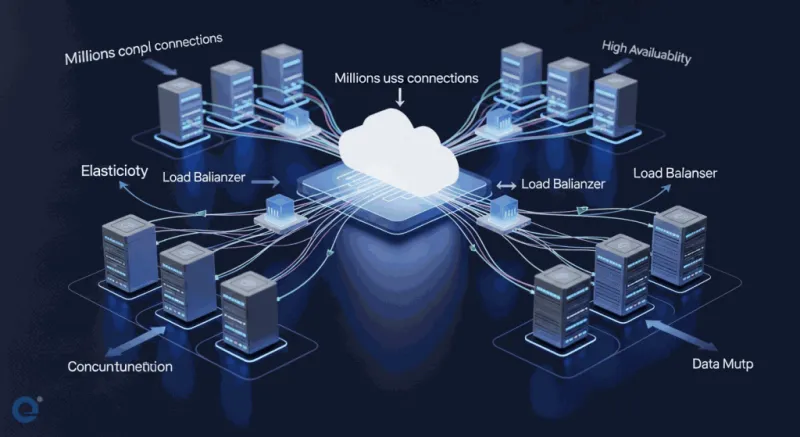
Photo: cloud server infrastructure load balancing startup technology, via eonsr.com
The conversation around high availability in infrastructure circles tends to move quickly toward multi-region deployments. Redundant data centers in separate US geographic zones, automated failover across cloud regions, globally distributed traffic routing — these are real and proven techniques. They are also expensive, operationally complex, and, for a large share of early-stage and growth-stage US startups, architecturally unnecessary.
The assumption that meaningful resilience requires enterprise-scale spending is worth examining carefully. For many teams, the path to reliable uptime runs not through additional regions, but through a more disciplined architecture within the region they already occupy.
Understanding What You Are Actually Protecting Against
Before committing to any redundancy strategy, it is worth being precise about the failure modes your business genuinely faces.
A full cloud region outage — where an entire geographic zone becomes unavailable — is rare. Major US cloud providers report these events infrequently, and when they occur, they typically affect a small fraction of customers. By contrast, the failure modes that cause most startup downtime are considerably more mundane: a single overloaded application server, a database that cannot handle a spike in concurrent connections, a deployment that introduces a breaking change, or a misconfigured load balancer.
Multi-region infrastructure is specifically designed to protect against regional failures. It does very little to protect against the application-level and configuration-level failures that actually bring most startups down. Investing in geographic redundancy before addressing those more common vulnerabilities is, in practical terms, solving the wrong problem.
The Foundation: Availability Zones Within a Single Region
Every major US cloud provider structures its regions into multiple availability zones — physically separate data centers within the same geographic area, connected by low-latency private networking. Distributing your infrastructure across two or three availability zones within a single region is the most cost-effective first step toward genuine resilience.
This configuration protects against the failure of any individual data center facility — power outages, cooling failures, network hardware faults — without the latency overhead or cost premium of a true multi-region deployment. Resources in different availability zones within the same region communicate with negligible latency, which means stateful applications remain practical without complex synchronization overhead.
For most US startups, this is the appropriate baseline. It is not a compromise. It is a well-calibrated response to the actual risk profile of the business.
Intelligent Load Balancing as a Resilience Mechanism
A load balancer is often treated as a traffic distribution tool, but its role in availability is equally significant. A properly configured load balancer performs continuous health checks on application instances, automatically routing traffic away from any server that fails to respond within acceptable parameters.
This means that a single failing application node does not produce user-facing downtime. Traffic shifts to healthy instances within seconds, often invisibly. The team receives an alert, investigates, and resolves the issue without a service interruption.
The key configuration decisions that determine how effective this protection is include health check frequency, failure thresholds before a node is removed from rotation, and the drain behavior for in-flight connections. These are not complex to configure, but they require deliberate attention. Default settings are often too conservative — slow to detect failure and slow to recover.
Running a minimum of two application instances behind a load balancer, distributed across separate availability zones, is a low-cost configuration that eliminates the single point of failure at the application tier.
Database Replication: Protecting Your Most Critical Asset
For most web applications, the database represents the highest-risk single point of failure. Application servers are stateless and replaceable. The database holds the state that cannot be reconstructed.
Within a single region, synchronous database replication to a standby replica in a separate availability zone provides strong protection against data center-level failures. In a synchronous replication model, every write is confirmed on both the primary and the replica before the transaction is acknowledged. Failover to the replica, when needed, involves no data loss.
Managed database services from major US cloud providers offer this configuration as a standard option, often referred to as Multi-AZ deployment. The cost premium over a single-instance database is meaningful but considerably less than the cost of a full secondary region deployment — and the protection against the most common database failure scenarios is comparable.
Read replicas offer an additional layer of value. By directing read-heavy queries to replica instances, teams reduce load on the primary database, improve query response times, and gain additional failover capacity. For startups experiencing read-heavy workloads — analytics dashboards, content-heavy applications, reporting features — this configuration can defer expensive database tier upgrades.
Edge Caching as a Resilience Layer
A content delivery network is typically discussed in the context of performance — reducing latency for geographically distributed users. Its role in resilience is less frequently emphasized, but it is substantial.
When static assets, API responses, and rendered page content are cached at edge nodes, a portion of user traffic can continue to be served even when the origin infrastructure experiences degraded performance. A misconfigured deployment, a database slowdown, or a sudden traffic spike may cause the origin server to struggle — but cached content continues to reach end users without interruption.
For US startups whose user base is geographically concentrated — a B2B SaaS serving customers primarily in the Northeast, for instance, or a consumer application with strong adoption in a few metro markets — a well-configured CDN layer provides meaningful resilience at a cost that is accessible even for early-stage budgets.
Automated Failover and Recovery: Reducing the Human Response Requirement
One of the practical advantages of well-designed single-region resilience is that failover can be automated without the complexity that multi-region architectures introduce.
Automated scaling groups that replace failed instances, managed database services that promote replicas without manual intervention, and load balancers that reroute traffic within seconds — these mechanisms reduce the window between failure and recovery to a duration that most users never notice.
Multi-region failover, by contrast, often requires DNS propagation, cross-region data synchronization checks, and manual validation steps that extend the recovery window significantly. The operational complexity of that process is frequently underestimated during the planning phase.
When Multi-Region Genuinely Becomes Necessary
This is not an argument against multi-region architecture in all circumstances. There are business contexts where it is the correct investment.
Regulatory requirements in certain US industries mandate geographic data redundancy. Applications with service-level agreements that specify sub-minute recovery time objectives may require it. Businesses with user bases distributed across the full continental US — where latency from a single East Coast or West Coast region creates a measurable experience gap — have a legitimate performance case for geographic distribution.
But these are specific, identifiable conditions. They are not the default situation for most startups. The default situation is a team that needs reliable uptime, a reasonable recovery posture, and a hosting budget that does not consume a disproportionate share of runway.
Building Resilience That Matches Your Stage
At HostInPlace, the infrastructure principle we return to consistently is proportionality. The right architecture is the one that matches your actual risk profile, your user expectations, and your operational capacity — not the architecture that looks most impressive on a system design diagram.
For US startups, a disciplined single-region approach built on availability zone distribution, intelligent load balancing, managed database replication, and edge caching delivers genuine resilience at a cost that preserves the resources needed to build the product itself. That is not a compromise. That is sound engineering judgment.